


Sending money through Venmo® is quick and casual, but when tax season rolls around, things can get complicated. Whether you’re splitting dinner, running a small business, or dabbling in crypto, it’s important to understand how Venmo taxes work and what the IRS expects from Venmo users.
This guide breaks down Venmo tax reporting, the Venmo 1099 rules, and how to tell when your Venmo payments count as taxable income.
What are Venmo taxes?
While “Venmo taxes” isn’t an official term, we’ll use it throughout this article to refer to how the IRS treats money you receive through payment apps like Venmo. In short, not all Venmo payments are taxable, but some must be reported on your tax return.
Here’s a breakdown of what types of transactions are taxable in Venmo:
| Type of payment | Taxable? | Example |
| Personal transactions | No | Splitting rent, reimbursements from friends, a family member sending you a cash gift |
| Business payments | Yes | Getting paid for freelance work |
| Sale of goods | Yes (if sold for a profit) | Selling furniture or handmade items (either as a hobby or formal business) |
Basically, if the money you’re receiving via Venmo counts as business income or profit from a sale of goods, it’s generally considered taxable income and needs to be reported, regardless of whether you get a tax form from Venmo.
Venmo users can easily differentiate between personal and business transactions by creating a dedicated Venmo Business Profile, which keeps business income separate from personal payments and gives your customers more flexible ways to pay. However, if you accidentally accept business payments on your personal profile instead of your business profile, those payments are still considered taxable income. Make sure you record all business payments through Venmo, from both your personal and business profiles.
Note: If you’re reselling personal items (like furniture, clothes, or electronics) for less than you originally paid, it’s generally not taxable. Only the profit from the sale of goods counts as taxable income. Learn more about the nuances of reselling in our guide to selling personal items on eBay®.
How Venmo tax reporting works
Venmo may send you Form 1099-K.
If you use Venmo for business transactions, you might receive a 1099 form from them, specifically Form 1099-K.
This form reports:
- Your total gross payments through Venmo
- Payments processed through the payment platform
- Third-party network transactions through Venmo from selling goods or services
Other 1099 forms you might receive
While Form 1099-K is the primary form tied to Venmo tax reporting, it’s not the only one that could show up depending on your activity.
Form 1099-MISC
- Form 1099-MISC may be issued for certain types of payments that don’t go through standard payment platform processing.
- Example: Fiat currency rewards, cryptocurrency rewards, or other miscellaneous income
Form 1099-DA (digital assets)
- Form 1099-DA is a newer tax form designed for crypto and cryptocurrency tax reporting.
- Example: Buying, selling, or exchanging crypto in your Venmo wallet
What is the Venmo 1099 threshold?
The Venmo 1099 threshold has been a moving target in recent years due to changes in tax law.
Current federal reporting threshold (updated rules)
Recent changes under the Working Families Tax Cut Act (a.k.a. One Big Beautiful Bill or OBBB) rolled back the lower threshold. The reporting requirements for Form 1099-K are now:
- $20,000 in gross payments, and
- 200+ business transactions during the calendar year
This means payment settlement entities like Venmo will generally issue a Venmo 1099-K form only if you had at least $20,000 in Venmo payments AND at least 200 transactions on the platform.
Note: These reporting thresholds apply specifically to Form 1099-K. Other forms, like Form 1099-MISC and Form 1099-DA, follow different rules and may be issued for certain types of income regardless of these limits.
The Venmo 600 rule explained
If you heard talk about the dreaded Venmo $600 rule in recent years, you no longer need to worry about it. A $600 reporting threshold was introduced in earlier tax law changes, but this was rolled back under the OBBB before it could be fully implemented.
If the changes had fully gone into effect, they would have dropped the federal reporting requirements from $20,000 over at least 200 transactions to $600, with no transaction minimum, meaning more Venmo users would have received Form 1099-K.
As it stands, the reporting threshold remains at $20,000 in gross payments over at least 200 transactions.
Tax Tip: While the $600 threshold no longer applies at the federal level, some states have lower reporting thresholds for Form 1099-K (some as low as $600). Because of this, you may still receive a 1099-K if you live in a state with a lower reporting threshold. Check with your state agency to confirm if your state reporting requirements differ from federal rules.
Don’t rely on a 1099 form to tell you what’s taxable.
It’s easy to assume you only owe taxes if you receive a Venmo 1099, but that’s not how the law works. In reality:
- The Venmo tax limit for receiving a Form 1099-K (at least $20,000 and at least 200 transactions) is just a reporting threshold for payment settlement entities.
- It does not determine what counts as taxable income.
- You may still owe income tax even if you don’t receive any tax documents from Venmo.
If you do receive Form 1099-K from Venmo, you will likely see at least $20,000 reported in Box 1a (your total gross payments), as well as at least 200 transactions listed in Box 3, as marked below:
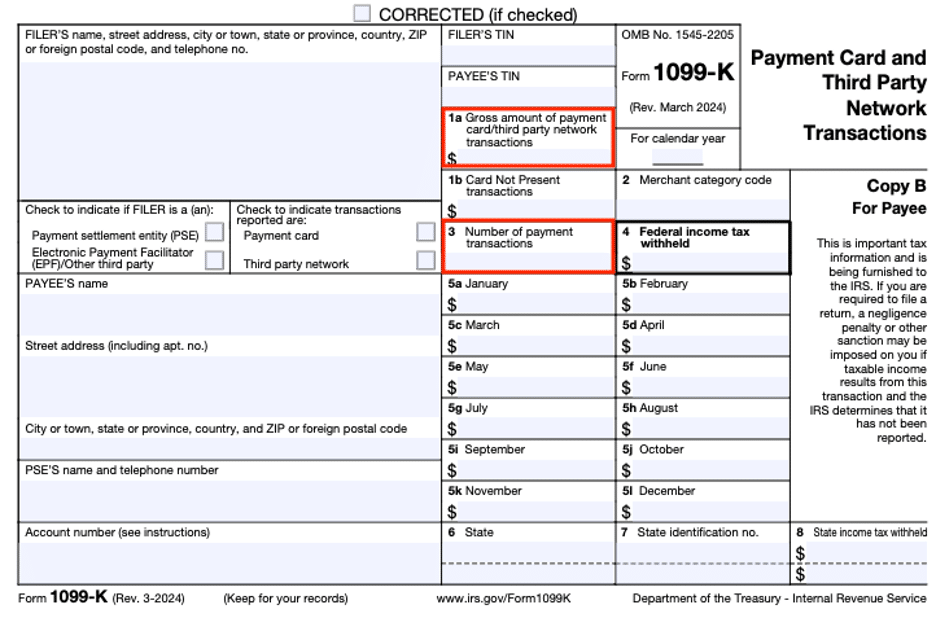
You generally need to meet both thresholds (for Box 1a and Box 3) to receive a Venmo 1099-K. But remember, even if you don’t hit these numbers, you’re still responsible for reporting any taxable income you earned — whether through business payments, a side hustle, or the sale of goods or services.
Let TaxAct help.
Don’t stress if this sounds complicated. If you file with TaxAct®, our software can walk you through your Venmo tax reporting step by step, helping you determine which Venmo payments are taxable income and making sure everything is reported correctly.
Tips to keep taxable and non-taxable transactions separate in Venmo
- Keep separate Venmo accounts for personal and business income
- Track all incoming payments, not just what shows up on a tax form
- Save receipts and maintain detailed records in case the IRS asks questions
Remember, the reporting rules for Form 1099-K don’t change your obligation to report taxable income. If you made money, it likely belongs on your tax return, whether Venmo reports it to the IRS or not.
Venmo taxes for individuals (personal use)
If you’re using Venmo solely as a peer-to-peer payment app for personal payments, you can generally relax.
Common non-taxable scenarios
- Paying your share of rent or utilities (or your roommates paying you)
- Sending or receiving money as a gift
- Receiving reimbursements from friends after a night out
- Splitting meals or travel costs with friends or family
These are considered personal transactions, not taxable income, so they don’t affect your tax liability and don’t need to be reported to the IRS.
Venmo taxes for small business owners and freelancers
If you’re a freelancer, self-employed, or a sole proprietor who takes business payments through Venmo, you need to report those transactions.
When Venmo payments become taxable
- You receive business payments for services.
- You sell products or digital goods for a profit.
- You operate a side hustle or small business.
All of this falls under business transactions and must be reported as taxable income, even if you didn’t earn enough to receive tax documents from Venmo. Keeping detailed records will help you keep everything organized so you can easily report it when filing your business taxes.
Keep in mind, though, as a business, you can offset your tax bill with legitimate business expenses (like supplies, software, mileage, etc.). Read more about tax deductions for businesses.
Venmo hobby income rules
If you occasionally earn money from a casual activity (think crafts, resale, or an unserious side gig you don’t run like a formal small business), the IRS may treat it as hobby income instead of business income.
Hobby income is still taxable income and must be reported on your tax return. However, hobby-related tax deductions are more limited than business deductions for a sole proprietor or self-employed individual. You generally can’t deduct hobby expenses the way you can business expenses.
If you’re unsure whether your side gig is a business or a hobby, check out our guide on hobby income vs. business income to understand the differences and how each affects your tax situation.
Venmo taxes for crypto investors
If you’re buying, selling, or using crypto through your Venmo wallet, the tax implications look a little different from standard personal transactions.
When crypto becomes taxable on Venmo
The IRS treats cryptocurrency as property, not cash. That means certain actions can trigger taxable income or capital gains.
You may owe taxes if you:
- Sell cryptocurrency for a profit.
- Trade one crypto for another.
- Use crypto to pay for goods or services.
Each of these is considered a taxable event (you should receive Form 1099-DA from Venmo) and must be reported on your tax return. Again, don’t panic! TaxAct can help you report your crypto transactions correctly.
What you need to report
- Capital gains or losses based on the difference between your purchase price and sale price
- Any crypto received as payment (which may count as business income if tied to services)
- Venmo will send you Form 1099-DA reporting all crypto activity, which you can use when filing your income tax return
Other payment apps
Tax rules don’t just apply to Venmo. The IRS treats these platforms similarly:
Even if you use multiple apps, you must combine all gross payments when calculating your taxable income. TaxAct can walk you through this process when filing your return.
How to avoid Venmo taxes
You can’t legally avoid paying taxes on taxable income, whether it comes through Venmo or another payment app. But you can take steps to reduce your overall tax bill while still staying compliant with IRS tax rules.
Smart ways to reduce your tax liability
- Claim eligible tax deductions related to your small business or freelance work.
- Track all business expenses.
- Keep clear records, separating personal transactions from business transactions.
- Maintain detailed records of all Venmo payments.
- Work with a tax professional or CPA if your tax situation gets complicated.
Taking these steps won’t eliminate your Venmo taxes, but they can help lower your tax liability and prevent unpleasant surprises during tax season.
FAQs
The bottom line
Using a payment app like Venmo doesn’t automatically mean you owe taxes, but it also doesn’t give you a free pass. If you’re receiving business payments, selling goods, or trading crypto through Venmo, you likely have tax reporting responsibilities. When using Venmo, make sure to track everything by correctly labeling your transactions, and don’t ignore your tax filing obligations. As always, the IRS doesn’t care how you got paid — only whether you report it.
Ready to tackle your tax return without the stress? TaxAct can help you report Venmo taxes, take business tax deductions, and file with confidence.
This article is for informational purposes only and not legal or financial advice.
All TaxAct offers, products and services are subject to applicable terms and conditions.
The OBBB is now also being referred to by lawmakers as the Working Families Tax Cut Act. You may see one or both names used here, but they refer to the same set of tax changes.
All trademarks not owned by TaxAct, LLC that appear on this website are the property of their respective owners, who are not affiliated with, connected to, sponsored by, or sponsors of TaxAct, LLC.