


As a parent or guardian filing taxes, you’ve likely claimed the Child Tax Credit (CTC). But what happens if the CTC reduces your tax bill to zero, and there’s still some credit left unused? That’s where the Additional Child Tax Credit, or ACTC, comes in.
Here’s how the ACTC works, who qualifies, and how to claim it for tax year 2026.
Note: The One Big Beautiful Bill (OBBB) is now also being referred to by lawmakers as the Working Families Tax Cuts Act. You may see one or both names used here, but they refer to the same set of tax changes.
At a glance:
- The ACTC is the refundable portion of the Child Tax Credit.
- Making part of the CTC refundable ensures that low-income filers can still take advantage of the credit, even if they don’t owe federal income tax.
- For 2026, the ACTC is worth up to $1,700 per qualifying child. It is the refundable portion of the total Child Tax Credit, which is worth up to $2,200 per qualifying child, not an additional $1,700 on top of that amount.
How the ACTC works
Is the Additional Child Tax Credit refundable?
Yes! The Additional Child Tax Credit refers to the refundable portion of the Child Tax Credit. Essentially, it’s a refundable tax credit that allows qualifying taxpayers to still get a full or partial refund even if they don’t owe any tax.
Unlike the nonrefundable credit portion of the CTC, which can only reduce your tax bill to $0, the ACTC allows you to receive a refund even if the credit is more than the tax you owe. This ensures that families with lower tax obligations can still benefit from the credit.
If you can’t use the full Child Tax Credit because your federal income tax liability is too low, you may qualify for the ACTC. Your refundable amount depends on your earned income, unused credit, and other eligibility rules, subject to the $1,700-per-child limit for 2026.
Who qualifies for the Additional Child Tax Credit?
To claim the ACTC, you must meet the applicable Child Tax Credit requirements and complete Schedule 8812. Under the standard earned-income calculation, you generally need more than $2,500 in earned income to receive a refundable amount. Special calculations may apply to certain taxpayers who have three or more qualifying children and are bona fide residents of Puerto Rico.
A qualifying child generally must:
- Be under age 17 at the end of 2026
- Be your child, stepchild, eligible foster child, sibling, half-sibling, stepsibling, or a descendant of one of these individuals, such as a grandchild, niece, or nephew
- Have lived with you for more than half the year, subject to applicable exceptions
- Not have provided more than half of their own support
- Be claimed as your dependent
- Be a U.S. citizen, U.S. national, or U.S. resident alien
- Not have filed a joint return, unless filing only to claim a refund of withheld income tax or estimated payments
Each qualifying child must have a Social Security number valid for employment and issued before the return’s due date, including extensions. You must also have a qualifying SSN. If you file jointly, only one spouse must meet that SSN requirement; the other spouse must have an SSN or ITIN issued by the return’s due date, including extensions.
You can’t claim the ACTC if you file Form 2555. To claim the credit, complete Schedule 8812 and attach it to your applicable federal income tax return.
How much is the Additional Child Tax Credit for 2026?
For tax year 2026, the total Child Tax Credit is worth up to $2,200 per qualifying child. Up to $1,700 of that amount may be refundable through the ACTC, depending on your earned income, unused credit, and other eligibility requirements.
Both maximum amounts are subject to inflation adjustments, but neither increased from 2025 to 2026.
The available credit begins to decrease when your modified adjusted gross income (MAGI) exceeds:
- $400,000 if married filing jointly
- $200,000 for all other filing statuses
These income thresholds apply to the overall credit, including any refundable ACTC portion.
Example ACTC calculation
Under the standard earned-income formula, the ACTC is generally calculated as 15% of the portion of earned income exceeding $2,500. The refundable amount is also limited by the unused Child Tax Credit and the $1,700-per-qualifying-child maximum for 2026.
Here’s a quick example:
- You earn $10,000 from a job
- Subtract the $2,500 threshold: $10,000 – $2,500 = $7,500
- Take 15% of that: $7,500 × 0.15 = $1,125
- Assuming you meet all eligibility requirements and have at least $1,125 of unused Child Tax Credit, your ACTC under this calculation would be $1,125
Your actual ACTC depends on all applicable limits.
As you can see, the actual calculation gets a bit complicated, but don’t worry; that’s what tax preparation software like TaxAct is for. We’ll help you crunch the numbers and claim the ACTC without stress.
How to claim the Additional Child Tax Credit
TaxAct makes it easy to claim the ACTC if you qualify. You don’t need to memorize IRS rules or do any complicated math. We’ll do the heavy lifting, and all you’ll need to do is answer some easy questions about your kids, earned income, and filing status to determine whether you meet all the eligibility requirements.
If all looks good, you’ll see a screen like the one below:
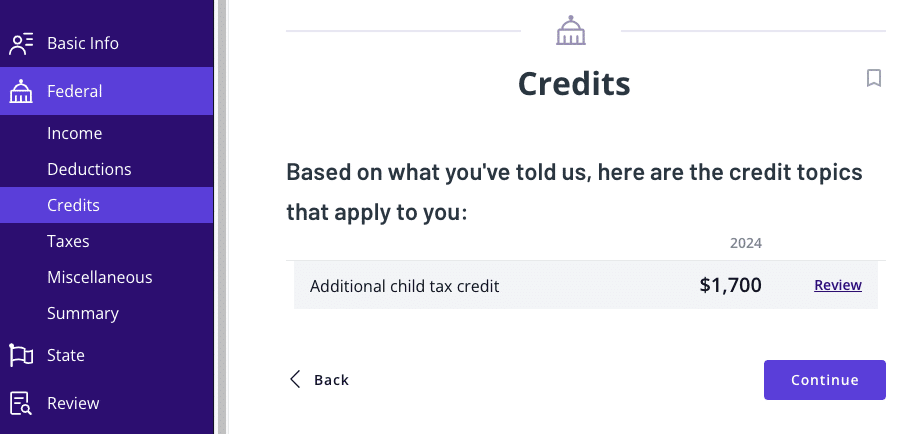
If you qualify for the ACTC, TaxAct will automatically apply it to your return — it’s that easy!
Additional Child Tax Credit FAQs
The bottom line
The Additional Child Tax Credit may provide a refund to eligible families who cannot use the full Child Tax Credit because their federal income tax liability is too low. For 2026, up to $1,700 per qualifying child may be refundable, depending on earned income, unused credit, and other eligibility requirements.
Under the standard calculation, you generally need more than $2,500 in earned income, although special calculations apply to certain filers. For 2026 returns filed in 2027, the IRS can’t issue refunds on returns claiming the ACTC before mid-Feb. 2027. Review your eligibility and plan your budget accordingly.
Ready to file your individual income tax return and claim your ACTC? Start your return with TaxAct, and we’ll help you identify the credits and deductions you qualify for.
Still have more questions? Ask us on Reddit!
Join the r/TaxActCommunity to ask questions, share tips, and hear from other filers and the TaxAct team.
This article is for informational purposes only and not legal or financial advice.
All TaxAct offers, products and services are subject to applicable terms and conditions.
Citations
Internal Revenue Service. Instructions for Form 2555, Foreign Earned Income. Internal Revenue Service, www.irs.gov/pub/irs-pdf/i2555.pdf. Accessed 28 Oct. 2026.
Internal Revenue Service. Schedule 8812 (Form 1040), Credits for Qualifying Children and Other Dependents. Internal Revenue Service, www.irs.gov/pub/irs-pdf/f1040s8.pdf. Accessed 28 Oct. 2026.